


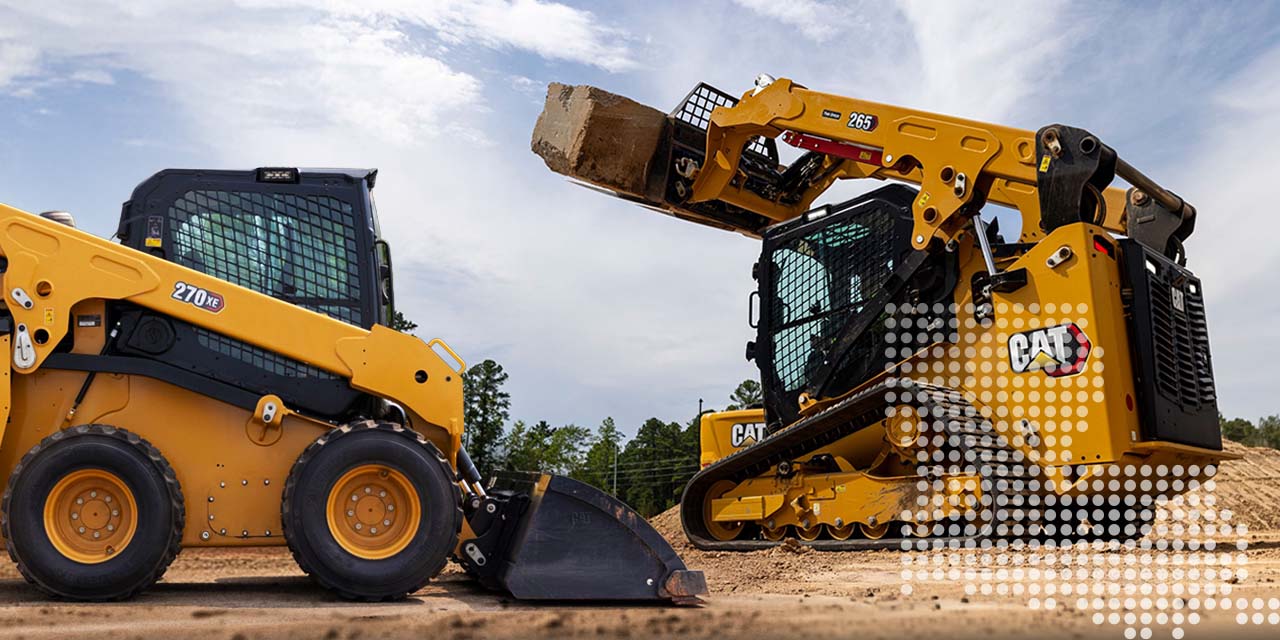
 Choose between a skid steer and a compact track loader by matching the machine to your jobsite conditions and budget. Opt for skid steers on firm, stable ground and choose compact track loaders for soft, wet surfaces.
While skid steers and compact track loaders perform similar jobs, the wrong machine for the terrain can cost you time, productivity and money. Consider other factors like maneuverability and lift capacity, which impact how efficiently you can get the job done.
Ground conditions will often be the deciding factor when choosing a skid steer or compact track loader because of the advantages and trade-offs of tires versus tracks. For example, on soft, boggy ground, a skid steer might sink, rut and get stuck, whereas a compact track loader will float across the same ground. In this case, other factors like superior speed or lift capacity won’t matter if your machine keeps getting stuck.
While ground conditions provide the foundation for your choice of machine, other factors should also form part of your decision, including:

Skid steer tires exert high ground pressure because four wheels provide a smaller contact area. This configuration is ideal for stable surfaces like concrete, asphalt and compacted gravel. Compact track loaders distribute weight across a larger surface area with a lower ground pressure, which is ideal for soft, wet, uneven ground or for surfaces you want to protect from damage.
Compared to compact track loaders, skid steers are faster on firm ground and more nimble in tight spaces. Their near-zero-radius turning is an advantage for urban sites, indoor work and jobs with limited access.
The gap in speed is measurable, but it’s narrower than most operators expect, and it only matters in specific situations. On paved yards, indoor demolition or any job that requires frequent repositioning across a firm surface, the extra speed adds up over a shift. On soft ground, slopes or sites where you’re grading or mulching, top speed is less important.
Skid steers also win on maneuverability in very tight spaces. Tracks are stable but wider, and the compact track loader’s longer footprint doesn’t turn as sharply as a wheeled machine. If the job involves threading between parked trucks in a warehouse yard or working inside a partial structure, the skid steer earns its place.
Skid steers typically cost less to buy and maintain, as tires are less expensive to replace than tracks, and skid steers have no undercarriage components to service. Track loaders may also cost more in fuel and transportation over the long run because of their heavier construction.
Consider hidden costs, such as using a skid steer on terrain that demands a compact track loader. If your machine is getting stuck, you could be losing hours of production or causing surface damage that takes more manpower and resources to fix. This quickly inflates the operating costs of your skid steer and makes a good case for a compact track loader.
When you compare spec sheets side by side, skid steers are usually rated at a higher tipping load percentage than compact track loaders. It looks like a clear win for the skid steer, but the two ratings aren’t measuring the same job.
The industry sets a lower-rated operating capacity (ROC) for compact track loaders because they routinely work on soft ground and slopes, where stability is a key challenge. Skid steers get the higher figure because they tend to operate on firm, level surfaces where the margin holds. Same math, different assumed conditions.
On flat, firm ground, a skid steer can move more at once. That’s an advantage for paved sites, warehouse floors and compacted gravel yards. But on soft ground or a sloped site, the compact track loader’s lower center of gravity and long track footprint take over. Even at the lower rating, it can hold a load more securely than a wheeled machine near its own limit.
Both machines use a similar range of attachments, so they can often perform the same jobs. However, with all the factors in mind, there are ideal applications for each type.
Skid steers excel for jobs involving:
Choose a compact track loader for:
Still need help narrowing down your decision between a skid steer and compact track loader? Let’s answer some frequently asked questions.
Both skid steers and compact track loaders are suitable for attachment work and often use many of the same attachment types, including buckets, forks, augers and brooms.
A compact track loader may be worth the extra cost if your terrain conditions consist of soft, wet or uneven ground. A compact track loader’s traction and ground-pressure advantages can translate directly into more productive hours and less downtime. This can offset the higher purchase price over a machine’s life. On firm, paved surfaces, choose a skid steer to maximize performance while keeping initial costs low.
Skid steers and compact track loaders could both suit Louisiana’s ground conditions, depending on your specific jobsite. For the state’s coastal soils, wetland-adjacent sites and post-rain clay conditions, the compact track loader has a clear advantage. Its low ground pressure keeps it moving on surfaces that would bog down a wheeled machine. For inland sites with firmer, well-drained soil, a skid steer may be adequate.
If you’re unsure which one would better fulfill your needs, renting a skid steer or compact track loader can be a great way to test each machine’s suitability for your fleet. It can also be ideal when you have mixed terrain, or need extra reinforcement or flexibility for hurricane events or peak season. Once you’re confident in your decision, you can purchase the right machine for your fleet.

Whatever your jobsite demands, we have the machine to perform at Louisiana Cat. Rely on our over 90 years of expertise as the region’s Cat® dealer. Browse our range of skid steers and compact track loaders now. If you’re still weighing up your options, experience the advantages of each machine firsthand with Louisiana Rents.