


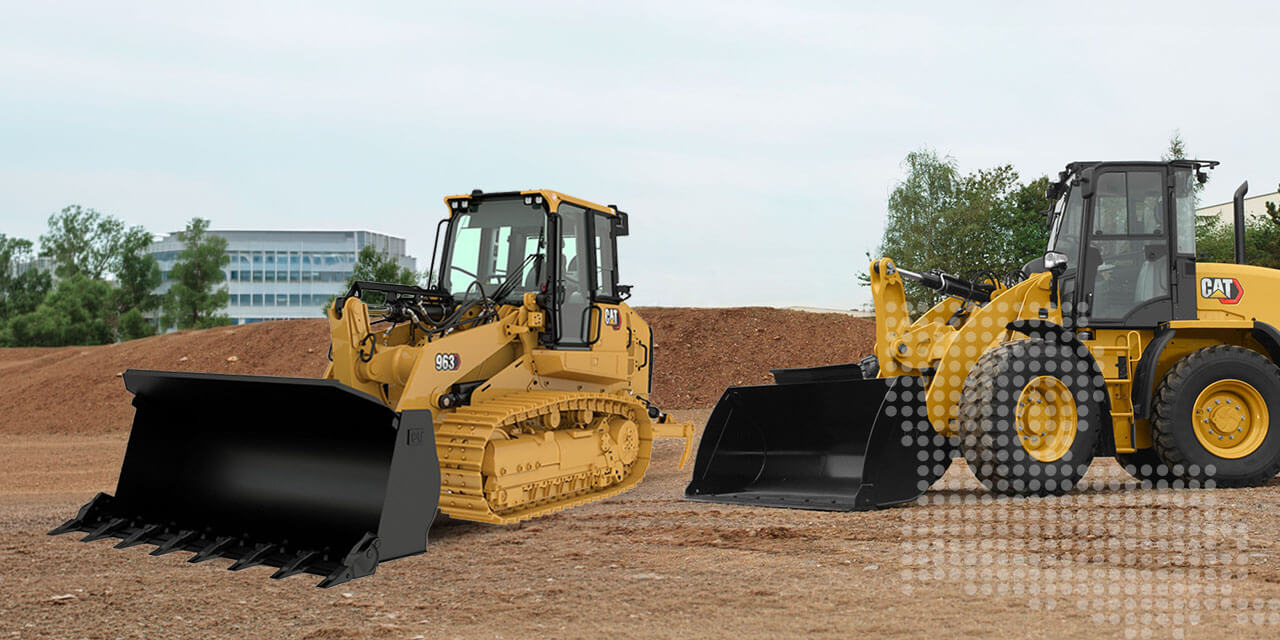
Choosing between a wheel loader and a track loader starts with the jobsite. Both handle material and site work, but ground conditions, application needs and operating costs should guide the choice. A wheel loader can lose traction on soft or saturated ground, while a track loader can add unnecessary undercarriage wear on paved or compacted surfaces.
Consider how the loader will spend most of its time. If the machine will travel often, load trucks from stockpiles or work on prepared surfaces, a wheel loader usually makes more sense. If the work involves soft ground, slopes, clearing or steady pushing, a track loader may be the better fit. The goal is to choose the machine that can complete the work with less downtime and better control.
Tracks spread machine weight across a longer contact area, helping lower ground pressure on soft, muddy or uneven terrain. For example, the 973 track loader can run from about 8.4 psi to 9.5 psi, depending on shoe configuration. That wider footprint helps it keep moving on ground that could rut, sink or slow a wheeled machine.
Wheel loaders are built for firm, paved or compacted surfaces, where ground pressure is usually less of a deciding factor. On concrete, asphalt, compacted gravel and hardpack, wheel loaders maintain full tire contact and move with less resistance.
Soft ground changes the equation. Wheel loaders carry their operating weight through four tire contact patches, so saturated clay, soft fill or wet terrain can lead to rutting, sinking and slower cycles.
Sloped or ungraded sites give track loaders another advantage. A low center of gravity and long track footprint give track loaders better stability and control on inclines, where a wheel loader may lose usable capacity. That stability matters on undeveloped sites, push-loading work and terrain that has not been graded yet.
Drainage and site prep also matter. A wheel loader may perform well on a firm yard after dry weather, but struggle after heavy rain or repeated traffic breaks down the surface. Track loaders handle changing conditions better because their undercarriage provides greater contact with the surface.
Travel speed matters when a machine moves between load points, covers a large site or repositions often during a shift. A midsize 966 GC wheel loader reaches about 21.6 mph in fourth gear. A comparable track loader tops out closer to 6 mph. That speed gap is one of the clearest differences between wheeled and tracked loaders when material has to move over longer distances throughout the day.
Track loaders are crawler loaders, so their lower speed is a design trade-off. The undercarriage that limits speed on hard ground also gives the machine more grip and control on slopes and soft terrain.
Wheel loaders use an articulated frame with a center hinge between the front and rear sections. That setup gives them a tight turning radius for high-cycle work like truck loading, stockpile work and crusher feeding. In a fixed work zone, landfill face, push-loading slope or ungraded area, traction, stability and pushing power matter more than travel speed.
Operating costs depend on more than the purchase price or hourly rate. Surface conditions, undercarriage wear, operator habits and maintenance planning all affect long-term cost:
Specs narrow the options, but the daily work cycle points to the better fit. Consider where the loader starts, how far it travels, what surface it crosses and where it dumps the material. A machine that looks best for one part of the cycle may not be the best fit once travel distance and ground conditions are factored in.

Wheel loaders fit applications built around firm ground and high-cycle work:
Track loaders fit jobs where pushing power, flotation or site prep are the priority:

With more than 90 years serving Louisiana contractors, our team understands the state’s jobsite conditions, soil types and daily operating demands. We carry Cat wheel loaders and Cat track loaders, so we can help you compare the right options for your work.
Contact us today to talk through your site, your application and the loader that fits the work ahead.